
Why fragmentation matters
Fragmentation is the size of the rock pieces after a blast. It is the main result of drilling and blasting, and the starting point for everything after it.
In an open pit, every tonne of rock is drilled, blasted, loaded, hauled and crushed. Drilling and blasting can be up to 30% of a pit's operating cost. When the blast leaves oversize rock that needs secondary blasting, this can rise to 50%. Loading and hauling can be another 50% (Oraee & Asi). Crushing and grinding use about a quarter of all the energy at a mine site (CEEC, 2021). The size of the rock decides how hard all of these steps are.
The blast is also the cheapest place to break rock. Breaking a boulder later, with a rock breaker, a second blast or a crusher, costs more time, more energy and more wear.
The main idea of this article: fragmentation is where the blast design meets the cost of the whole mine. We look at how fragmentation is measured, what controls it, what it changes in the operation and the cost, where the common gaps are, and how GEOVIA Surpac can help close them.
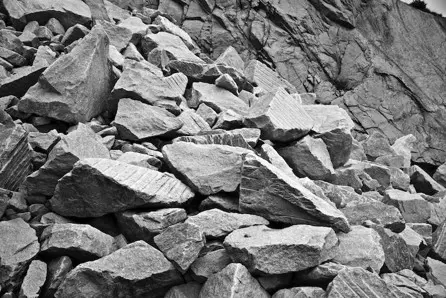
How we describe fragmentation
A blast never gives one rock size. It gives a mix of fines, medium pieces and some large blocks. So we describe the mix with a few numbers:
d50 (or P50): half of the rock, by weight, is smaller than this size.
d80 (or P80): 80% of the rock is smaller than this size. Mines often set a d80 target that suits the shovel and the crusher.
Oversize: pieces too big for the bucket or the crusher opening.
Fines: very small pieces. In a quarry, too many fines can mean lost product.
There are two ways to get these numbers:
Measure them after the blast. Photos of the muckpile are analysed by software. At the Gol-E-Gohar iron ore mine, 30 to 60 photos were taken during loading after each blast (Oraee & Asi). Today, cameras on shovels, trucks and crushers can do this every day.
Predict them before the blast. The most common model is Kuz-Ram. It uses the rock, the explosive, the powder factor and the pattern to estimate the rock size. It is useful for comparing designs, but it has limits: it does not fully describe the rock mass, so it must be checked and adjusted with site measurements (Oraee & Asi).
The best practice uses both: predict, blast, measure, and adjust the next design.
What controls fragmentation
Three groups of factors decide the rock size. The rock mass is set by nature. The blast design is set by the engineer. The execution is done by the drill and blast crew. A good result needs all three.
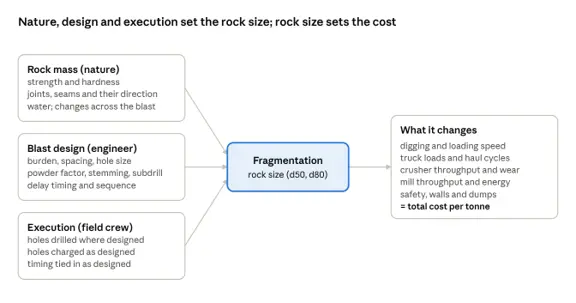
1. The rock mass: set by nature
Strength and hardness. Harder rock needs more energy to break. Hardness can change a lot inside one blast. At a Pilbara iron ore mine, single blast areas ranged from soft to extra hard (Perincek et al., 2025b).
Joints and their direction. Joints are natural cracks. Rock with many close joints is already broken into blocks, so it needs less explosive. The Bamberton quarry in Canada uses a lower powder factor than other quarries for this reason (CMR, 2022). The direction of the main joint set also matters (Konya & Walter, 1991):
joints parallel to the face: holes link too early and the rock comes out blocky;
joints at right angles to the face: more backbreak behind the blast, and blocks between large holes;
joints at an angle to the face: usually good fragmentation;
joints at less than 30° to the face: blocky rock and a shattered back wall.
Mud seams and open cracks. The explosive gas escapes through them, so the rock around them breaks poorly (Konya & Walter, 1991).
Water. Wet holes need a water-resistant explosive such as emulsion, which changes both the energy and the cost.
We cannot change the rock. But we can map it and fit the design to it.
2. The blast design: set by the engineer
| Design factor | How it affects fragmentation | Sign that it is wrong |
|---|---|---|
| Burden and spacing | Together with powder factor, the most sensitive factors. At Gol-E-Gohar, a spacing of 4.5 to 5.8 m gave a d80 of 28 to 40 cm (Oraee & Asi). | Too tight: too many fines and higher cost. Too wide: boulders and secondary blasting. |
| Powder factor (energy) | More energy per cubic metre gives smaller rock, up to a point. | Too low: boulders and a tight muckpile that is hard to dig. Too high: fly rock, fines, and a flat muckpile that needs more passes to fill the bucket (Perincek et al., 2025b). |
| Bench height to burden (H/B) | Called the stiffness ratio. 1 is poor, 2 is fair, 3 is good, 4 or more is excellent (Konya & Walter, 1991). | A low ratio gives boulders, toe problems, fly rock and vibration. |
| Hole diameter | Bigger holes allow a wider pattern, but the energy is spread less evenly. | Coarser rock, more vibration and fly rock. |
| Stemming | Keeps the gas in the hole. About 0.7 times the burden is a common start (Konya & Walter, 1991). | Too short: fly rock and air blast. Too long: boulders from the top of the bench. |
| Subdrill | Breaks the rock down to the floor level. | Too little: hard humps (toes) on the floor. Too much: wasted drilling. |
| Delay timing | As important as burden and spacing. Good timing gives better breakage with no extra explosive (Konya & Walter, 1991). | Too fast between rows: the rock blows up instead of moving forward, with coarse rock and fly rock. |
Timing is often forgotten. In one mine described by Konya & Walter, a change in timing alone improved fragmentation and cut the stemming needed to control blowout by 60%.
3. Execution: done in the field
The design only works if it is built as drawn. Holes drilled in the wrong place or at the wrong angle change the real burden and spacing. Drilling accuracy depends on the operator, the drill type, the hole depth and the local geology (Konya & Walter, 1991). Charging matters too: the right product, the right amount and the right stemming in every hole. At the Bamberton quarry, every hole design is reviewed with the driller, and any hole that does not follow the standard loading procedure is recorded and discussed before the blast (CMR, 2022).
What fragmentation changes in the operation
Every team after the blast works with the rock size the blast gives them. Rock that is too coarse causes problems, and so does rock that is too fine or thrown too far.
| Area | When the rock is too coarse | When the rock is too fine, or the blast has too much energy |
|---|---|---|
| Digging and loading | Slower digging and more shovel delays. At a Ghanaian open-pit gold mine, the shovels met their 2.4-minute truck loading target mainly when the d80 target was met; loading was slower in periods of coarser rock (Aalto University thesis). | The muckpile spreads flat, so the shovel needs more passes to fill the bucket (Perincek et al., 2025b). |
| Hauling | Trucks are poorly filled, so more trips are needed. Large blocks can damage the trucks (Metso, 2018). | Rock thrown far from the face takes longer to clean up, and ore and waste can mix. |
| Primary crusher | Boulders block the crusher. Throughput drops, power spikes, and liners wear faster (Metso, 2018). | In a quarry, too many fines can mean lost product and a more complex plant (Oraee & Asi). |
| Grinding mill | Coarser feed lowers mill throughput and raises energy use. At Porgera gold mine, blasts with more energy raised SAG mill throughput by up to 15% (AusIMM, 2003). | Little extra benefit after a point, while the blasting cost keeps rising. |
| Secondary breaking | Boulders need a rock breaker or a second blast: more cost, more delays and more risk. | – |
| Safety and neighbours | Extra secondary blasts add risk and noise. | Fly rock, air blast and dust, often from poor confinement or too much energy (CMR, 2022). |
| Walls, floor and dumps | Hard humps (toes) on the floor and blocky backbreak. Rock size also affects the stability of waste dumps (Oraee & Asi). | Cracked and loose final walls from too much energy behind the blast. |
The message of the table is simple: there is a target size range, not a "smaller is better" rule. The right target depends on the shovel, the crusher, the plant and the product.
What it costs
Fragmentation moves cost from one department to another. A wider pattern lowers the drilling and blasting bill, but the saving can be lost, and more, in loading, crushing and grinding. A tighter pattern does the opposite.
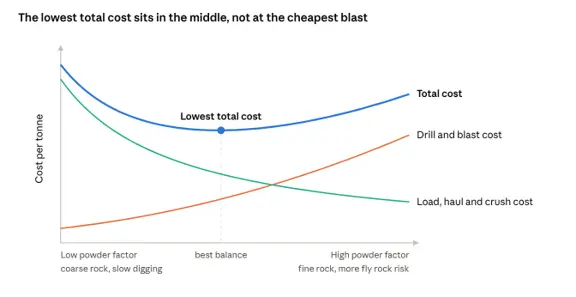
Examples from mines show both sides:
Saving on explosive can cost more later. At the Ghanaian gold mine above, the operator reported savings of at least USD 2.3 million per year from using less explosive with a wider pattern. The study concluded that this saving was not economic once the effects on loading and crushing were counted (Aalto University thesis).
Spending more on the blast can pay back in the plant. At Porgera, the blasts used more explosive energy, and they raised SAG mill throughput by up to 15% (AusIMM, 2003).
Both extremes cost money. At Gol-E-Gohar, a spacing tighter than the best range gave too many fines and higher drilling and blasting cost. A wider spacing gave boulders and secondary blasting (Oraee & Asi).
Fitting the pattern to the rock pays off. In a simulation study of 10 blasts at a Pilbara iron ore mine, patterns with burden and spacing matched to the local hardness came about 9% closer to the target rock size, using about 13% fewer holes than fixed patterns (Perincek et al., 2025b).
So the right question is not "what is the cheapest blast?" It is "what blast gives the lowest total cost per tonne, from the blast to the crusher or mill?"
Where the gaps usually are
Most mines know the theory above. The problems are usually in the gaps between geology, design, field work and results:
One pattern for changing rock. Most designs use one burden and spacing for the whole blast, even when the rock changes from soft to extra hard inside it (Perincek et al., 2025b).
Geology does not reach the design. Geological models, mapping and drilling data exist, but they are not always used by the blast designer. Data from drill sensors is still largely unused (Perincek et al., 2025a).
The design is not built as drawn. Holes are drilled off position or at the wrong angle, or charged differently from the plan (Konya & Walter, 1991).
Timing is an afterthought. Konya and Walter (1991) call timing is one of the most important design factors, and also the one most often neglected.
No feedback loop. Fragmentation is not measured, or the results are not linked back to the design that produced them. Testing many designs by trial blasts alone is slow and expensive (Oraee & Asi).
Each department judges its own cost. Drilling and blasting is judged on its own budget, not on the total cost per tonne.
How GEOVIA Surpac can help close the gaps
Software cannot replace field measurement or the engineer's judgement. But many of these gaps are about data, records and checking options, and this is where a mine planning tool such as GEOVIA Surpac can help. Its drill and blast tools work on the same surveyed surface and geological data that the mine already uses for planning.
| Gap | How GEOVIA Surpac can help |
|---|---|
| One pattern for changing rock | Draw rock-class zones, for example from the geological model, and let GEOVIA Surpac use a different burden and spacing in each zone. |
| Geology does not reach the design | Save design defaults for each rock class: burden, spacing, subdrill and drilling cost. Every designer starts from the same approved values. |
| The design is not built as drawn | Design each hole on the surveyed surface and clip the pattern to the real bench crest. Print work order reports for the drill and charging crews, with the details of every hole. |
| Timing is an afterthought | Tie in holes by hand or from templates (V, diagonal), edit the delays, and watch the firing as an animation before the blast. |
| No feedback loop | Every pattern, charge and report is saved in a drill and blast database. When the field team measures the fragmentation, it can be compared with the exact design that produced it, and good designs can be reused. |
| Each department judges its own cost | The blast summary report gives drill metres, explosive, rock volume, powder factor, drilling cost and explosive cost for each design option. Options can be compared in minutes and shared with the loading and plant teams. |
The real value is in the loop: design, blast, measure the result in the field, learn, and design the next blast a little better.
Conclusion
Fragmentation is the link between the blast design and the cost of the whole mine. Nature sets the rock, the engineer sets the design, and the field crew builds it. All three decide the rock size, and the rock size decides how fast the shovel digs, how full the trucks are, how much the crusher and mill can process, and how safe the pit is.
The goal is not the cheapest blast or the smallest rock. It is the right rock size for the lowest total cost per tonne. Mines reach that goal by fitting the design to the rock, building it as drawn, measuring the result and improving step by step. Good tools make each turn of that loop faster.
How does your mine measure fragmentation today, and does that result go back to the blast designer? Share your experience in the comments.
Sources
Oraee, K. & Asi, B., Prediction of Rock Fragmentation in Open Pit Mines, using Neural Network Analysis (University of Stirling repository): cost shares, Gol-E-Gohar spacing and powder factor results, limits of Kuz-Ram.
Perincek, O., Loxton, R., Kulkarni, S. & Arthur, D. (2025a), Drill and Blast Decision Support to Optimize Hole Position, Explosives, and Drill Bit Clusters, Mining, Metallurgy & Exploration 42: 2011–2022.
Perincek, O., Loxton, R., Kulkarni, S. & Arthur, D. (2025b), Drill Pattern Optimisation for Large Complex Blasts to Improve Fragmentation and Dig Efficiency, Mathematical Geosciences 57: 577–599.
Konya, C. J. & Walter, E. J. (1991), Rock Blasting and Overbreak Control, US Federal Highway Administration: joints, stiffness ratio, stemming, timing, drilling accuracy.
Coast Mountain Resources (2022), Drill and Blast Overview, Bamberton Quarry: joints and powder factor, loading procedures, fly rock and vibration control.
Productivity improvement of a Ghanaian open-pit gold mine through rock fragmentation optimization (Aalto University, master's thesis).
Porgera Joint Venture, Dyno Nobel and JKMRC (2003), Implementation of mine to mill blast optimisation at Porgera gold mine, AusIMM.
Metso (2018), Three reasons why your primary crusher feed contains oversized rocks.
CEEC (2021), report on mining energy use, via CIM Magazine.
GEOVIA Surpac 2026 Refresh 1, Drill and Blast tutorial (Dassault Systèmes): the Surpac functions in the table.