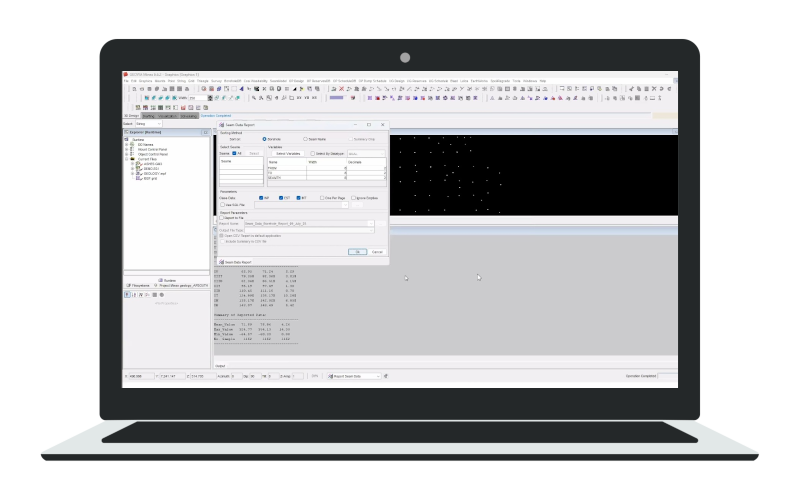
Minex Geology solution uses all available data (i.e. geophysics, qualities, lithology, washability, and structural) to correlate and interpret the deposit. A user-configurable borehole database, with ODBC connectivity to the world’s leading corporate borehole databases (e.g., Access, Oracle, acQuire, SQL Server). Borehole data management also interfaces with acQuire databases for data downloads and interpretation uploads.
Mine Survey-related process which is traditionally performed in native desktop Surpac software will be extended to the 3DEXPERIENCE platform with the following supporting roles:
Borehole Database and Seam Modeling
Minex Borehole Database and Seam Modeling module provides two main functionalities to help geologists effectively model coal seams.
Minex is equipped with a user-configurable borehole database, with ODBC connectivity to the world’s leading corporate borehole databases (e.g., Access, Oracle, acQuire, SQL Server). It interfaces with acQuire databases for data downloads and interpretation uploads. The function enables effective and efficient data validation and auditing; fast and accurate Multi-Seam, Multi-Variable Modeling builds entire models, including seam floor, thickness, quality, and other surfaces.
Seam modeling in Minex allows for the management of complex stratified deposits, Minex can handle up to 500 seams and layers. Minex’s geological modeling utilizes automated grid generation to quickly model large complex deposits. Several interpolating methods are available to let users generate the best possible representation of natural surfaces. Additional tools allow users to model complex structural considerations such as splitting, merging, and missing seams.
This module allows resource modeling and resource evaluation where users can: create economic ratio grids that incorporate costs and revenues; report resources that meet requirements of international guidelines such as JORC; create distance grids (constrained by thickness, ash, energy, etc.), and classify coal within distance categories; define physical constraints such as cutoff thickness, depth, strip ratio, or within polygons; establish ore quality ranges to meet various product specifications; and produce customized reports in CSV format using templates.
Coal Washability
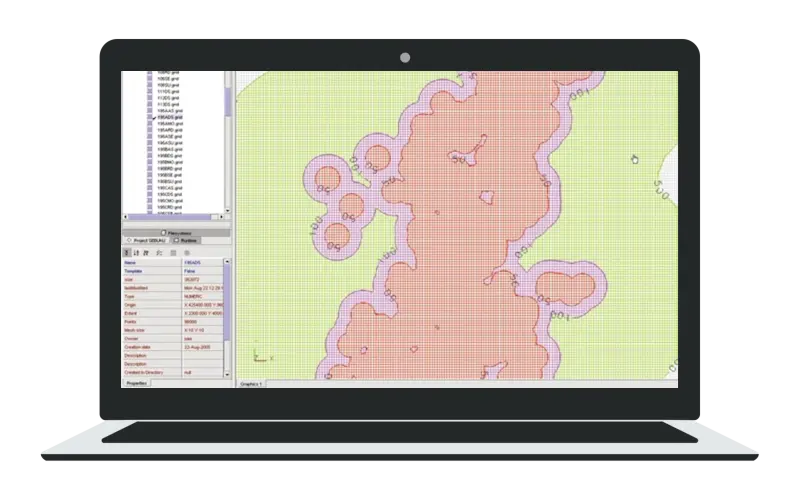
Minex Coal Washability module models complete wash curve so that yield, ash, and other analyses can be modeled across the entire deposit, letting users: store and analyze size and density data in the coal washability database; load both incremental and cumulative samples.
The module allows users to composite data for modeling, plotting, and reporting by; cumulative size, specific wash densities, product ash targets and yields; report primary, secondary, and tertiary product grades and yields; and compute product grade grids for coal production requirements. Users can then use these grids in resource and reserves reports to simulate plant processes by area or schedule time
3D Fault Modeling
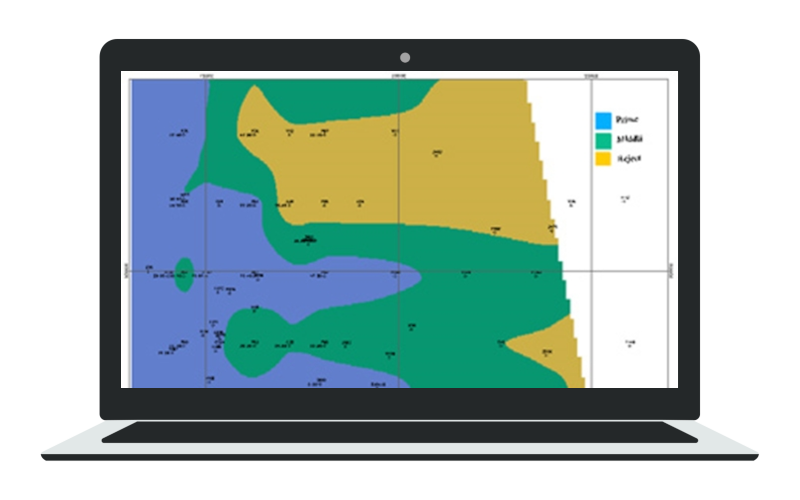
Minex 3D Fault Modeling module supports the analysis of normal and reverse faults. It allows the generation of blocks between faults and the limits of the deposit.
The un-fault and re-faulting method enables users to un-fault the borehole seam positions to create the geologic model and refault the geologic model.

Geostatistics
Minex Geostatistics module supports coal quality modeling and captures variations in coal by heat content, SO2 content, HCl content, and mercury content among other characteristics.
To capture differences in the sulfur and heat content of coal, a two-letter “coal grade” nomenclature is used. Minex takes the borehole samples and does numerical modeling to represent the coal quality of a particular variable. This module allows users to define modeling parameters for each different quality type and then using the Multi-Seam Multi-Variable capabilities model a whole formation as one process.