
A Smarter Way to Design Open Pits
Open pit mine design is an iterative engineering process that requires continuous refinement as geological data, production targets, and operational conditions evolve. Engineers are expected to evaluate multiple design scenarios within increasingly tight project schedules while ensuring safety, operational efficiency, and economic performance (Hustrulid et al., 2013).
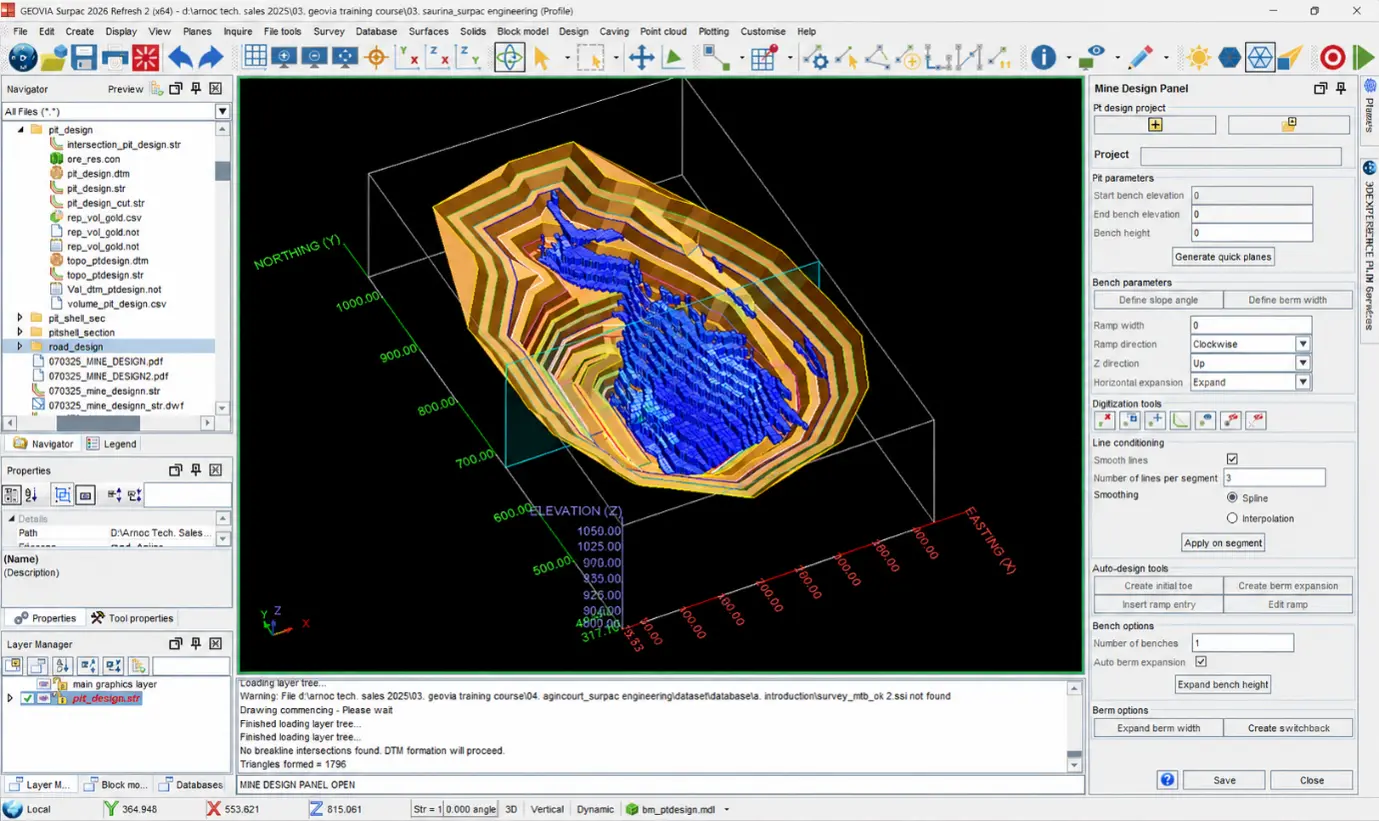
Although modern mining software provides powerful design capabilities, repetitive tasks such as modifying benches, ramps, berms, and switchbacks can interrupt workflow and reduce productivity. To address this challenge, GEOVIA Surpac 2026 Refresh 2 introduces the Mine Design Panel, a centralized workspace that simplifies routine pit design activities and enables engineers to focus more on engineering decisions than software navigation
Why Mine Design Needs Better Workflows
Mine planning is a continuous process rather than a one-time activity. As projects evolve, engineers frequently revise pit geometry to accommodate updated resource models, geotechnical recommendations, production targets, and operational strategies (Hustrulid et al., 2013).
These revisions often involve the same design elements:
Bench and berm configuration
Ramp alignment and gradients
Switchback placement
Pit geometry adjustments
Reducing repetitive software interactions allows engineers to evaluate more design alternatives while improving planning efficiency.
What's New in GEOVIA Surpac 2026 Refresh 2
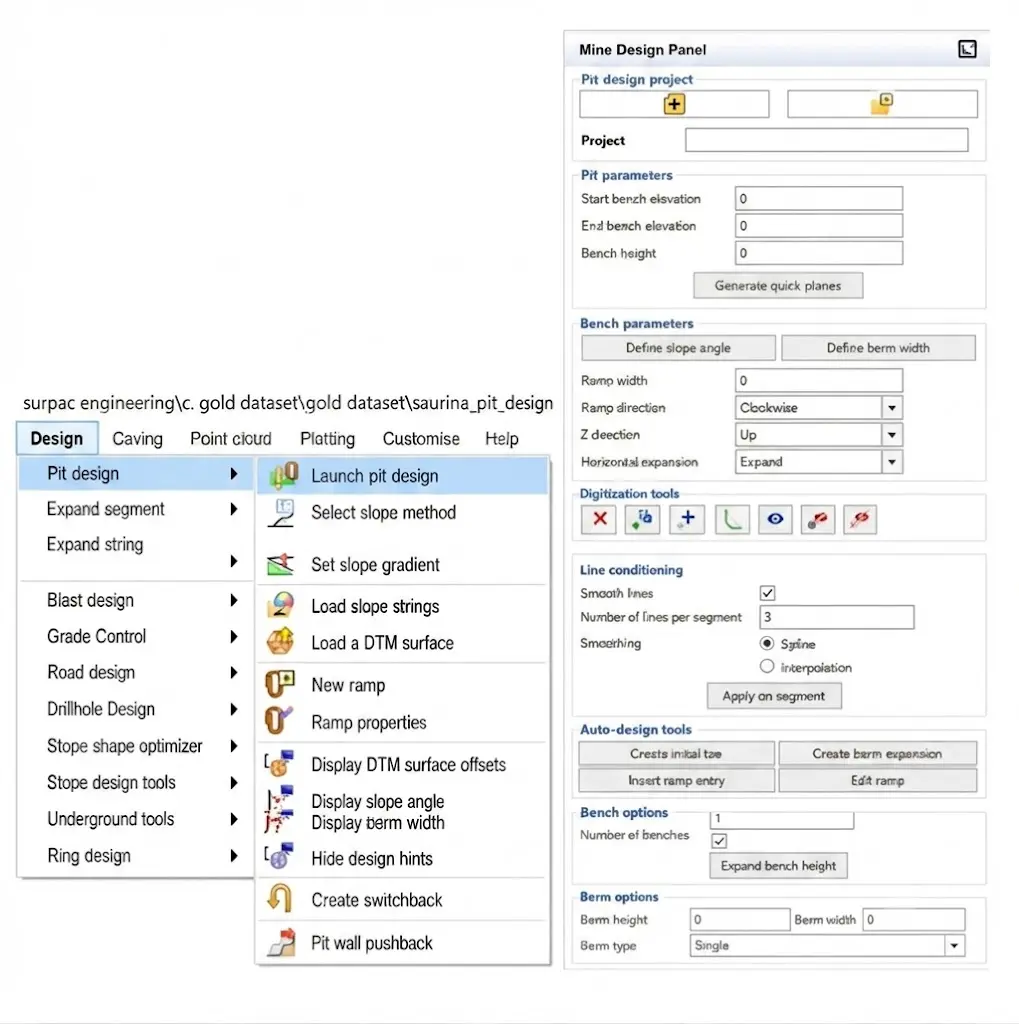
The Mine Design Panel introduces a more intuitive way of performing routine pit design task. Instead of searching through multiple menus, engineers can access the most frequently used design tools from a single workspace.
This enhancement does not replace existing design functions. Instead, it reorganizes them into a streamlined interface that minimizes repetitive navigation while maintaining the flexibility required for detailed mine design.
Quick Pit Plane Creation
Every pit design starts with defining an initial pit geometry. Creating this foundation efficiently is important because it influences the speed of subsequent design activities.
The Mine Design Panel allows engineers to generate pit planes more quickly, providing a smoother transition from conceptual layouts to detailed engineering designs.
Key Benefits
Faster conceptual pit development
Reduced repetitive commands
Improved workflow consistency
Bench and Berm Configuration
Bench geometry plays a critical role in slope stability, mine safety, and operational efficiency (Read & Stacey, 2009). The Mine Design Panel allows engineers to configure bench heights and berm widths within a centralized workflow, making design updates faster and more consistent.
Key Benefits
Simplified bench configuration
Consistent berm geometry
Improved design efficiency
Ramp Design and Editing
Haul roads directly influence truck productivity, fuel consumption, and operating costs (Thompson & Visser, 2003). The Mine Design Panel simplifies both ramp creation and editing by allowing engineers to define gradients, road widths, and entry locations from one workspace.
Key Benefits
Faster ramp creation
Simplified ramp editing
Consistent haul road design
Efficient Switchback Generation
As pit depth increases, haul roads inevitably become more complex. Switchbacks are commonly used to maintain safe operating gradients while minimizing unnecessary haulage distances.
Instead of manually constructing these geometries, the Mine Design Panel provides a dedicated workflow for generating switchbacks more efficiently. This not only reduces manual design effort but also helps maintain consistent haul road geometry throughout the pit.
Key Benefits
Reduced design time
Improved haul road continuity
Simplified workflow
Flexible Bench Expansion
Mine designs rarely remain static. Engineers frequently adjust bench widths or elevations in response to updated geotechnical recommendations, revised production schedules, or optimization studies.
The Mine Design Panel simplifies these revisions by allowing bench expansions to be completed more efficiently while preserving overall pit geometry. This flexibility supports faster evaluation of alternative mining scenarios without requiring engineers to recreate existing designs.
Key Benefits
Faster design revisions
Better support for iterative planning
Increased engineering flexibility
More Than New Tools—A Better Engineering Experience
The greatest advantage of the Mine Design Panel is its ability to improve engineering workflow rather than introduce entirely new design methods.
Research in strategic mine planning highlights the importance of enabling engineers to evaluate more scenarios while reducing repetitive engineering tasks (Blom et al., 2024). Likewise, adaptive mine planning approaches emphasize flexible workflows that can respond efficiently to changing geological information (Khalifi et al., 2026).
By consolidating commonly used pit design tools into one interface, the Mine Design Panel helps engineers spend less time navigating software and more time developing practical mining solutions.
Conclusion
The Mine Design Panel in GEOVIA Surpac 2026 Refresh 2 provides a more efficient approach to open pit design by centralizing essential functions such as pit plane creation, bench and berm configuration, ramp development, switchback generation, and bench expansion.
As mine planning projects become increasingly complex, efficient workflows are just as important as powerful engineering tools. By reducing repetitive design tasks and simplifying software navigation, the Mine Design Panel enables engineers to focus on delivering safe, practical, and optimized mine designs.
References
Blom, M., Pearce, A. R., & Côté, P. (2024). Long-Term Mine Planning with Large Neighbourhood Search. arXiv.
Hustrulid, W. A., Kuchta, M., & Martin, R. K. (2013). Open Pit Mine Planning and Design (3rd ed.). CRC Press.
Khalifi, H., Caers, J., Taha, Y., et al. (2026). Adaptive Mine Planning under Geological Uncertainty: A POMDP Framework for Sequential Decision-Making. arXiv.
Read, J., & Stacey, P. (2009). Guidelines for Open Pit Slope Design. CSIRO Publishing.
Thompson, R. J., & Visser, A. T. (2003). Mine Haul Road Design and Management Best Practices for Safe and Cost-Efficient Truck Haulage. Surface Mining Conference Proceedings.