
In mining operations, a production schedule is never static. Equipment breakdowns, changing production targets, ore grade variability, and unexpected field conditions can quickly make an existing schedule obsolete.
Without an adaptive scheduling process, even small operational changes can impact productivity, resource utilization, and production targets (Dassault Systèmes, n.d.; Darling, 2011).
What Makes Mine Scheduling Challenging?
Dynamic production targets
Equipment availability and maintenance
Changing ore grades and blending requirements
Haulage and stockpile constraints
Mining sequence dependencies
Unpredictable field and weather conditions
How GEOVIA MineSched Helps
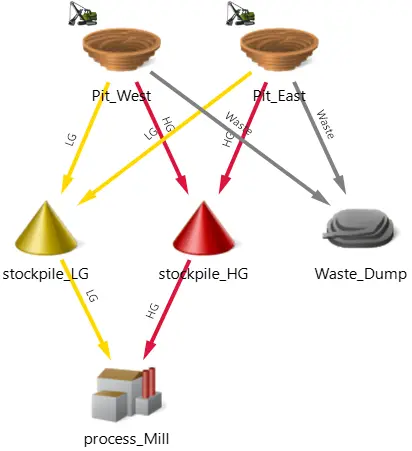
GEOVIA MineSched enables mining engineers to build constraint-based production schedules by considering multiple operational factors simultaneously, including:
Production targets
Equipment and workforce capacity
Mining precedence and sequencing
Ore quality and blending requirements
Haulage routes and transportation constraints
Stockpile management
This allows planners to quickly evaluate scheduling scenarios and update production plans without rebuilding the entire schedule (Dassault Systèmes, n.d.).
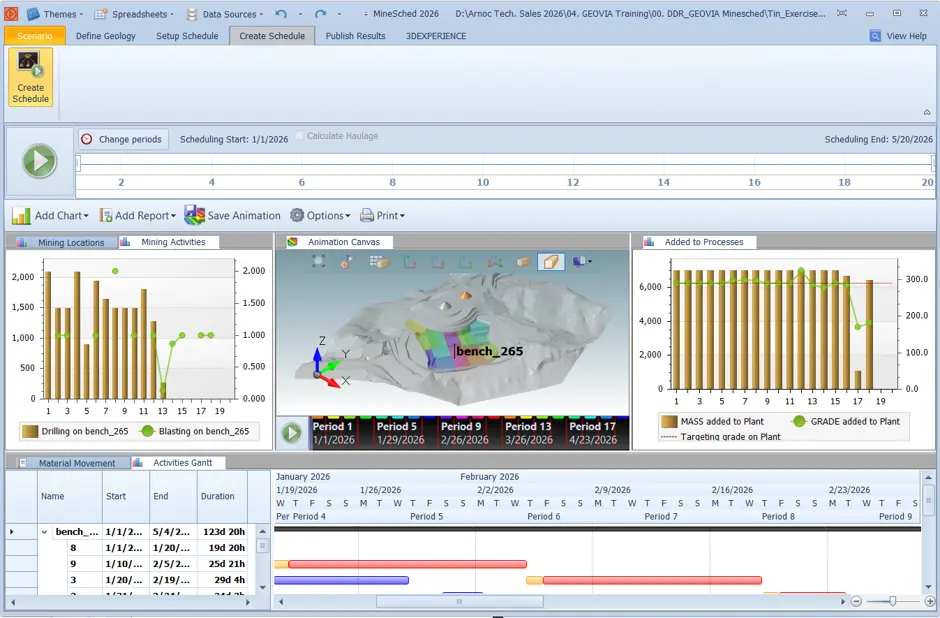
Why It Matters
Improve production consistency
Maximize equipment utilization
Reduce scheduling time
Respond faster to operational changes
Support data-driven decision making
An optimized schedule isn't just about meeting production targets it's about creating a plan that remains practical and executable when mining conditions change.
Reference
Dassault Systèmes. (n.d.). GEOVIA MineSched.
https://www.3ds.com/products/geovia/mineschedDassault Systèmes. (n.d.). GEOVIA Solutions.
https://www.3ds.com/products/geoviaDarling, P. (Ed.). (2011). SME Mining Engineering Handbook (3rd ed.). Society for Mining, Metallurgy & Exploration.
Kennedy, B. A. (Ed.). (1990). Surface Mining (2nd ed.). Society for Mining, Metallurgy & Exploration.