
Introduction
Coal remains one of the world's primary energy sources for large-scale electricity generation. Despite the ongoing transition toward renewable energy, its abundance, reliability, and affordability continue to make it an essential component of the global energy mix. As a result, coal mining remains critical for supporting energy production and industrial development, and is expected to continue playing an important role until alternative energy sources can reliably meet a significant portion of global demand.
However, sustaining profitable coal production has become increasingly challenging. Many coal operations are facing deeper and more complex deposits, rising stripping ratios, fluctuating commodity prices, and growing pressure to improve productivity while maintaining environmental responsibility. Studies have shown that changes in stripping ratios and economic conditions can significantly influence mining performance and operational decision-making (Bakkula et al., 2025; Wang et al., 2024).
In this environment, production efficiency is not created in the pit—it is created during planning.
Mine Planning as the Foundation of Mining Success
Mine planning serves as the bridge between geological knowledge and mining execution. It transforms exploration data into practical mining strategies that guide extraction activities, equipment deployment, production scheduling, and resource management.
The importance of mine planning has long been recognized within the mining industry. According to Newman et al. (2020), mine planning encompasses a wide range of decisions that directly affect operational efficiency, resource recovery, and project economics throughout the mine lifecycle.
A well-designed mine plan helps mining companies answer critical questions:
Which areas should be mined first?
How much waste must be removed to access coal?
How can production targets be achieved consistently?
What mining sequence will maximize profitability?
How can coal quality requirements be maintained throughout the mine life?
Key Planning Components That Drive Production Efficiency
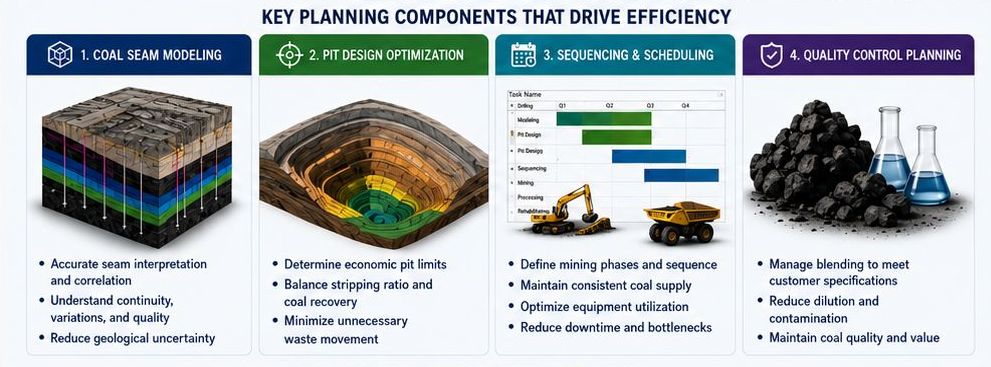
Coal Seam Modeling
Every successful coal mine begins with a reliable geological model. Accurate seam modeling enables engineers to understand seam continuity, thickness variations, fault structures, and coal quality distribution throughout the deposit.
By reducing geological uncertainty before mining begins, companies can minimize unexpected operational disruptions and improve confidence in production forecasts.
Pit Design Optimization
Pit design plays a crucial role in determining the economic viability of a mining operation. Engineers must carefully balance coal recovery against waste removal requirements to develop economically optimized pit boundaries.
Even small improvements in pit design can significantly reduce unnecessary waste movement, lower operating costs, and improve overall resource utilization.
Mining Sequence and Production Scheduling
Determining where and when material will be extracted is equally important. Effective production scheduling ensures that mining activities align with processing requirements, equipment availability, and business objectives.
A well-structured schedule helps maintain consistent coal supply, maximize equipment utilization, and reduce production interruptions throughout the operation.
Coal Quality Management
Meeting market specifications is another critical component of production efficiency. Variations in ash content, moisture, sulfur, and calorific value can directly affect product value and customer satisfaction.
Through proper planning and blending strategies, mining companies can maintain product consistency while maximizing recovery from available resources.
Leveraging Advanced Planning Tools for Better Decisions
Modern mine planning software has transformed the way mining engineers evaluate and optimize mining strategies. Rather than relying solely on manual calculations and static plans, engineers can now build digital models that support rapid analysis and scenario evaluation.
Digital mine planning technologies enable engineers to convert exploration and operational data into integrated planning models that support more effective decision-making (Kunytska, 2023).
Advanced planning solutions allow teams to:
Build detailed geological models from exploration data.
Estimate resources and reserves with greater confidence.
Optimize pit designs based on economic parameters.
Evaluate multiple mining scenarios.
Develop production schedules aligned with operational constraints.
Assess project performance under changing market conditions.
Research by Wang et al. (2024) demonstrates the value of evaluating alternative mine plans under varying economic conditions, particularly in response to fluctuations in coal prices and changing pit boundaries.
Similarly, Liu and Guo (2023) highlighted the importance of dynamic production scheduling approaches in improving operational performance and responding to changing mining conditions.
Supporting Coal Mine Planning with GEOVIA Minex
For coal and other stratified deposits, specialized planning tools are essential. GEOVIA Minex is designed specifically to address the unique challenges associated with seam-based deposits, providing an integrated workflow from geological modeling through mine design and production scheduling.
Using GEOVIA Minex, mining teams can transform exploration data into actionable mine plans through a structured workflow:
Import and validate exploration data.
Build detailed coal seam models.
Estimate coal resources and reserves.
Design economically optimized pit layouts.
Develop production schedules and mining sequences.
Evaluate operational and financial outcomes through scenario analysis.
By integrating these processes within a single platform, engineers can improve planning accuracy, reduce uncertainty, and accelerate decision-making.
The Business Impact of Effective Mine Planning

Investing in effective mine planning generates benefits that extend throughout the entire mining value chain.
Organizations that adopt data-driven planning approaches often achieve:
Higher resource recovery.
Reduced waste movement.
Improved equipment productivity.
More reliable production performance.
Better cost control.
Faster response to changing market conditions.
Increased confidence in strategic decision-making.
Ultimately, effective planning allows mining companies to maximize the value of their resources while maintaining operational flexibility in an increasingly challenging industry.
Conclusion
Accurate geological understanding, optimized mine designs, effective scheduling, and proactive scenario analysis provide the foundation for efficient and profitable mining operations. As highlighted by Newman et al. (2020), effective mine planning remains one of the most important drivers of mining performance, influencing decisions from resource extraction through production delivery.
References:
Bakkula, O., Wibisono, D., & Siallagan, M. (2025). Examining the drivers of changes in stripping ratio in open pit coal mining: A system dynamics model to optimize the coal discrepancy. Discover Applied Sciences, 7(2), 112–125.
Kunytska, M. (2023). Digital simulation of open-pit mining organisation system. International Journal of GEOMATE, 25(109), 197–204. https://doi.org/10.21660/2023.109.m2321