
Introduction
Drilling and blasting is one of the techniques used to break hard material in various industries, including mining and quarrying. This technique involves controlled blast hole drilling, explosives charging, and firing the blast holes sequentially to break the rock into manageable pieces. It is a traditional and effective method applied in various mining commodities, including polymetallic, quarry, and coal mining, depending on the strength and hardness of the material that needs to be managed for various objectives, such as:
Rock fragmentation
Opening access to locations
Saving time and cost
Surface leveling
Improving operational efficiency
Matching topography contours to design contours
Blasting requires careful planning, from selecting the correct type of explosives, defining the blast pattern, and determining the amount of explosives, to implementing proper safety procedures in order to avoid hazards and minimize environmental impacts. There are a few parameters that significantly influence drill and blast design, such as:
Geometrical parameters
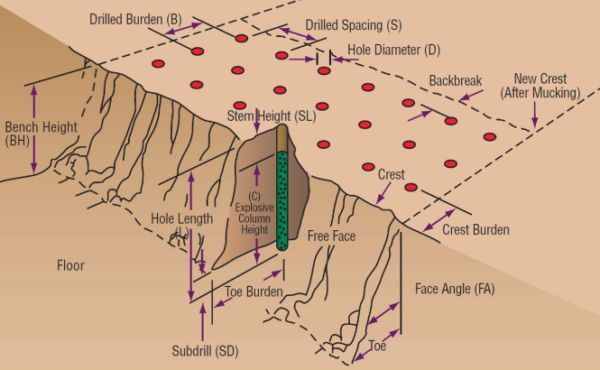
These include burden, which is the distance from the explosive charge to the nearest free face, spacing between blast holes, bench height, drill hole diameter, stemming height, sub-drilling depth, and powder factor, which is expressed as kilograms of explosive per cubic metre of rock (Shirazi et al., 2015).
Blasting Pattern
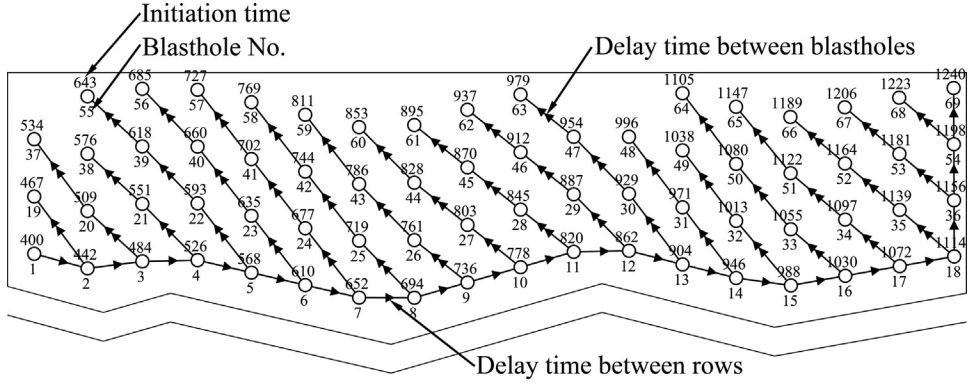
The blasting pattern defines the sequence of detonation of individual blast holes. The presence of a blasting sequence means there is a time interval between detonations, known as delay time. A well-designed delay timing sequence is critical in controlling blast energy distribution, minimizing environmental impacts, and optimizing fragmentation and muckpile movement. Proper delay timing can reduce ground vibration, minimize overbreak and flyrock, and improve the overall blasting results.
Rock mass properties
The mechanical properties of the rock mass play a decisive role in blasting performance. Factors such as rock type, rock mass classification, and the interaction with applied blast energy must be considered when predicting fragmentation outcomes (Mutinda et al., 2021). Each rock type has different mechanical properties; therefore, each requires a different amount of blast energy to achieve optimal fragmentation. Various rock mass classification systems can be used to better understand these characteristics and support blasting design like RMR, GSI, and Q-System.
Explosive characteristics and powder factor
The choice of explosive and the resulting powder factor are critical design variables. Optimization of blasting parameters is essential since the fragmentation obtained affects the cost of all interrelated mining activities, including drilling, blasting, loading, hauling, and crushing (Sankovsky, 2017).
Although blasting always involves some level of uncertainty, several parameters can still be controlled during planning, such as geometrical parameters, explosive utilization (powder factor), and the blasting pattern including firing sequence.
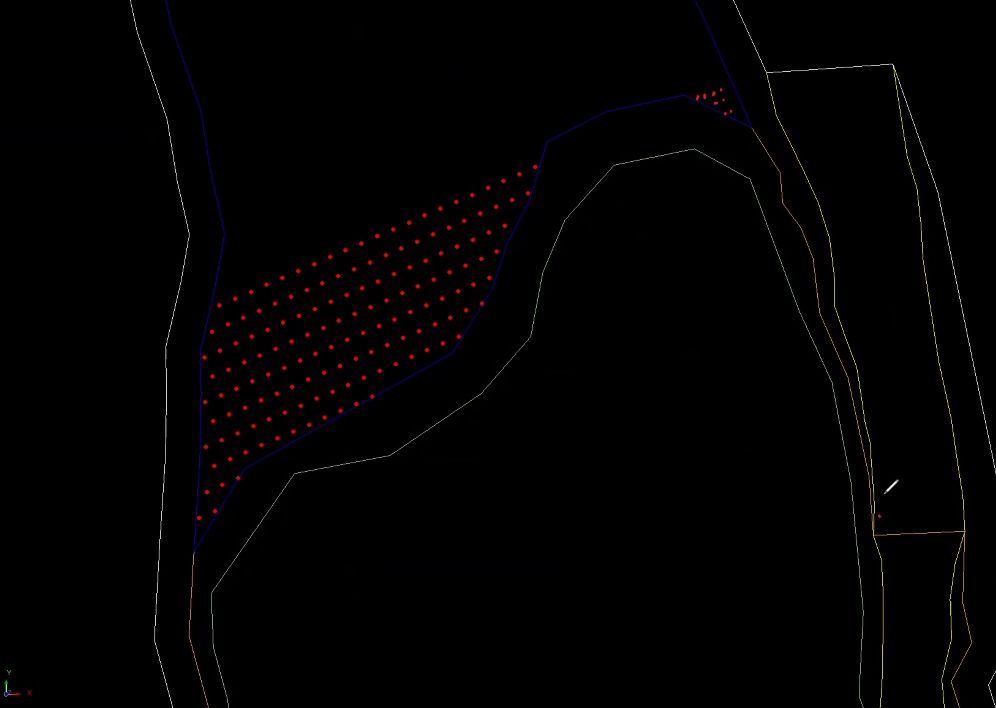
Drill and blast design can be effectively planned using GEOVIA Surpac Drill and Blast Design, starting from managing the drill and blast database for blasting domains, configuring blast hole geometry, setting up firing sequences, and finally generating design and volumetric reports.
Learn More Through Our Webinar
To gain deeper insights into drill and blast optimization in quarry operations, PT Arnoc Indonesia Energi is hosting a live webinar:
Blasting Beyond Limits: Optimizing Drill & Blast in Quarry with GEOVIA Surpac
In this session, you will learn:
Practical challenges in quarry blasting
How to optimize drill and blast design
The role of digital tools like GEOVIA Surpac
Strategies to improve operational efficiency
🗓 Date: Thursday, May 21, 2025 ⏰ Time: 10.00 – 12.00 WIB
Reference:
U.S. Department ofthe Interior’s Office of Surface Mining. (n.d.). Blaster’s Training Modules - Module 3 - Surface - Blast Design.
Hidayatullah, R., & Salmani. (2019). Teknik Peledakan (1st ed.). POLIBAN PRESS.
JOUAV Unmanned Aircraft System. (2024). The Ultimate Guide to Drilling and Blasting. JOUAV Unmanned Aircraft System. https://www.jouav.com/blog/drilling-and-blasting.html
Gheibi, S., Aghababaei, H., Hoseinie, S. H., & Pourrahimian, Y. (2009). Modified Kuz—Ram fragmentation model and its use at the Sungun Copper Mine. International Journal of Rock Mechanics and Mining Sciences, 46, 967–973. https://doi.org/10.1016/j.ijrmms.2009.05.003
Mutinda, E. K., Alunda, B. O., Maina, D. K., & Kasomo, R. M. (2021). Prediction of rock fragmentation using the Kuznetsov-Cunningham-Ouchterlony model. Journal of the Southern African Institute of Mining and Metallurgy, 121(3), 107–112. https://doi.org/10.17159/2411-9717/1401/2021
Sankovsky, M. M. Y. and A. A. (2017). DRILLING AND BLASTING DESIGN BASED ON INVARIABLE MINING PARAMETERS. Journal of Industrial Pollution Control, 931–936.
Shirazi, A., Mohebbi, J., & Tabatabaee, H. (2015). ADAPTIVE-NEURO FUZZY INFERENCE SYSTEM (ANFIS) MODEL FOR PREDICTION OF BLAST-INDUCED GROUND VIBRATION a b c. SCIENCE INTERNATIONAL, 27, 2079–2091.
Liu, J., Sun, P., Liu, F., & Zhao, M. (2014). Design and optimization for bench blast based on Voronoi diagram. International Journal of Rock Mechanics and Mining Sciences, 66, 30–40. https://doi.org/10.1016/j.ijrmms.2013.11.012