
When a vehicle enters a curve, drivers experience an outward force that becomes stronger at higher speeds or on sharper curves. To maintain vehicle stability, reduce skidding, and improve safety, engineers design curved road segments with a slight tilt known as superelevation (AASHTO, 2018).
Superelevation works together with road friction and vehicle weight to counteract the centrifugal force that pushes vehicles outward. Without proper superelevation design, vehicles—especially heavy trucks and buses—face a higher risk of sliding outward, losing control, or even rolling over when navigating curves (PUPR, 2017).
Understanding Centrifugal Force
Centrifugal force is the apparent outward force felt by a vehicle as it moves along a curved path (Garber & Hoel, 2019). Although it is not a “real” force in strict Newtonian mechanics, drivers experience it clearly when navigating turns, especially at higher speeds or on sharper curves.
Mathematically :
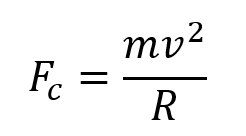
where :
m = mass of the vehicle
v = speed
R = radius of the curve
Interpretation:
Higher vehicle speed → stronger outward force
Smaller curve radius → stronger outward force
Greater vehicle mass → stronger outward force
This is why heavy vehicles like buses, trucks, and mining haul trucks face much higher rollover risk on curves (SME, 2011)
What Is Superelevation?
Superelevation is the method of raising the outer edge of a curved road so the pavement slopes inward toward the curve’s center (AASHTO, 2018). This design helps reduce centrifugal force and improve vehicle stability on horizontal curves.
Benefits of Superelevation:
Better directional stability
Less dependence on tire friction
Safer speeds through curved road sections
Reduced skidding during wet conditions (PIARC, 2012)
In Indonesia, the recommended maximum superelevation for highway design is 8–10% (PUPR, 2011).
How Superelevation Reduces Centrifugal Force
By tilting the road surface, part of the vehicle’s weight creates a horizontal force that helps resist centrifugal force. This decreases the load on tire friction and enhances safety when vehicles travel through curves (Garber & Hoel, 2019).
Design Relationship: Superelevation, Friction, and Centrifugal Force
Where:
v = design speed
g = gravitational acceleration
R = curve radius
f = allowable side friction factor
This equation ensures:
Curves are safe at the intended speed
Drivers have an adequate margin of safety
Roads perform well under various weather and traffic conditions
Engineering design must find the optimal balance (PUPR, 2017).
Typical Design Standards
Different countries adopt varying maximum superelevation values:
Indonesia: 8–10% depending on terrain
AASHTO (USA): up to 12% for highways
India: max 7% for plain terrain
Designers must also consider:
Climate (rainfall, snow, ice)
Urban vs rural context
Heavy vehicle proportion
Drainage at the curve
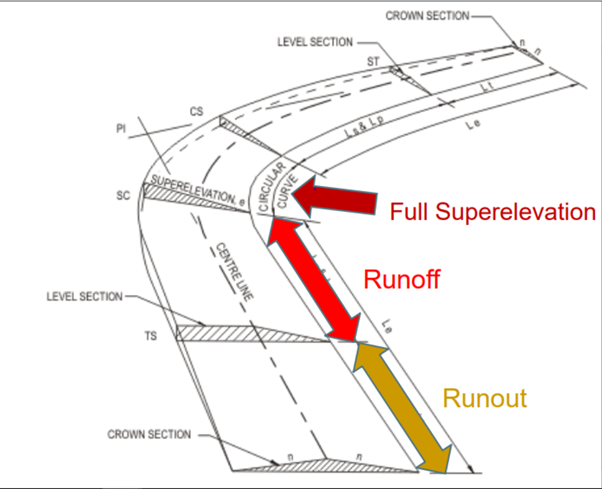
Stages of Superelevation Installation
According to Indonesian geometric design standards (PUPR, 2017), applying superelevation in the field involves three key stages:
Run-Out – Reducing the normal cross slope until the pavement becomes flat.
Run-Off – Rotating the pavement from zero slope to the desired superelevation.
Full Superelevation – Maintaining the maximum cross slope throughout the main curve.
These stages ensure smooth transitions, comfort, and safe vehicle handling.
Superelevation Applications in Different Road Types
Highways and Expressways
On high-speed roads, superelevation is essential to maintain vehicle stability and improve safety during wet-weather conditions (PIARC, 2012). Proper road tilt helps reduce centrifugal force on long, sweeping curves.
Mountain Roads
Mountain routes feature sharp curves and steep gradients that generate significant lateral forces. Effective superelevation is critical to support safe cornering and prevent vehicles from sliding outward (Garber & Hoel, 2019).
Mining Haul Roads
Superelevation is especially important on haul roads due to:
Extremely heavy vehicle loads
High center of gravity
Elevated rollover risk
Correct superelevation design increases safety, reduces accident potential, and minimizes operational downtime in mining environments (SME, 2011).
Conclusion
Superelevation and centrifugal force play a vital role in road geometric design. By balancing speed, curve radius, pavement friction, and roadway tilt, engineers ensure that vehicles can navigate curves safely and smoothly. A well-designed superelevation system reduces crash risks, enhances cornering stability, and supports safe travel at the intended operating speeds—making it a key element in safe and efficient road design.
References
AASHTO. (2018). A Policy on Geometric Design of Highways and Streets (7th ed.). American Association of State Highway and Transportation Officials.
Garber, N. J., & Hoel, L. A. (2019). Traffic and Highway Engineering (6th ed.). Cengage Learning.
Kementerian Pekerjaan Umum dan Perumahan Rakyat. (2011). Standards for Urban Road Geometric Design (No. 19/BM/2011). Directorate General of Highways.
Kementerian Pekerjaan Umum dan Perumahan Rakyat. (2017). Geometric Design of Intercity Roads (No. 03/BM/2017). Directorate General of Highways.
PIARC. (2012). Road Design Guide. World Road Association.
SME. (2011). SME Mining Engineering Handbook (3rd ed.). Society for Mining, Metallurgy, and Exploration.